
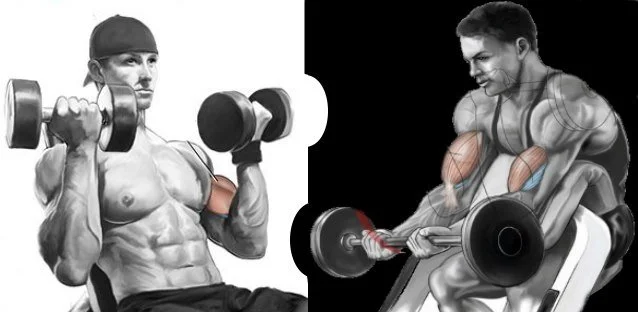
Which exercise builds a bigger biceps peak: incline dumbbell curl or preacher curl?
Developing a pronounced biceps peak is a common goal for many lifters. Two popular contenders for this purpose are the incline dumbbell curl and the preacher curl. Each emphasizes different parts of the biceps and uses different ranges of motion and biomechanics, so understanding how they load the muscle will help you choose—or combine—them for better peak development. For context on the underlying mechanics of curls and how exercise choice affects hypertrophy, see this research-based discussion on curls.
Muscle anatomy and what “peak” means
The visible biceps peak mainly comes from the long head of the biceps brachii. The biceps has two heads:
- Long head: runs along the outer portion of the arm, contributes more to the peaked appearance when well-developed.
- Short head: sits more on the inner arm, contributes to overall mass and width.
Peak appearance is influenced by genetics (insertion points, muscle bellies) and by targeted hypertrophy of the long head. Exercise selection matters because different movements place the long and short heads under varying amounts of stretch and contraction.
How each curl targets the biceps
-
Incline dumbbell curl
- Biomechanics: Performed seated on an incline bench with the arms hanging behind the torso. This starting position places the long head under a greater stretch before contraction.
- Muscle emphasis: The increased pre-stretch on the long head tends to increase tension across its mid-to-long length during the concentric phase, which is favorable for long-head (peak) hypertrophy.
- Range of motion: Longer ROM allows for strong eccentric loading and full contraction at the top.
- Stability/difficulty: Requires shoulder stability; using dumbbells allows slight rotation to find an individually comfortable path.
-
Preacher curl
- Biomechanics: Performed with the upper arms supported and fixed on a preacher bench, limiting shoulder movement and isolating elbow flexion.
- Muscle emphasis: The fixed position reduces involvement of the shoulder and can bias the short head and brachialis depending on grip and elbow angle. It’s excellent for strict isolation and peak contraction but usually with less long-head pre-stretch than the incline variant.
- Range of motion: Limits cheating and momentum; often stronger at the mid-range and top.
- Stability/difficulty: High isolation and safe for heavy, strict reps; easier to maintain form for time under tension.
Which builds a bigger peak?
Mechanically, the incline dumbbell curl has the edge for stimulating the long head because of the increased stretch at the shoulder joint. Stretch-mediated hypertrophy (gaining muscle by loading it while elongated) is a well-supported principle; exercises that put the long head on a greater pre-stretch tend to be better for peak development. That said, preacher curls are valuable for isolating the biceps, improving mind-muscle connection, and adding volume without shoulder involvement.
Practical takeaways:
- For prioritizing the peak (long head): incline dumbbell curls are often the better choice due to increased long-head stretch and full ROM.
- For strict isolation, detail work, or loading the mid/top range: preacher curls are very effective and can complement incline work.
- Best results usually come from including both variations in a program at different intensities, rep ranges, and tempos.
Programming and variations
- Rep ranges: Use 6–12 reps for hypertrophy as a baseline. Include sets with slower eccentrics and full stretch for incline curls to emphasize long-head stimulus.
- Volume & frequency: 8–20 sets/week per muscle group is typical for hypertrophy; distribute elbow flexion work across 2–3 sessions.
- Variation ideas:
- Incline alternating dumbbell curls: reduce bilateral fatigue and allow focus on each arm’s peak.
- Incline hammer curls: emphasize the brachialis and may help push the biceps up, improving peak appearance indirectly.
- Preacher curl pauses or iso-holds at peak: increase time under tension for the short head and top-end thickness.
- Don’t neglect compound pulling movements (rows, chin-ups) for overall arm mass and functional strength. Also consider core stability work to support pressing and pulling—if you want structured routines that include core training, check out this core stability and ab workout guide.
Practical sample session (example)
- Warm-up: light band curls, shoulder mobility.
- Primary long-head focus: 3–4 sets incline dumbbell curls, 8–12 reps, slow 3–4s eccentrics.
- Secondary isolation: 3 sets preacher curls, 8–12 reps, strict form.
- Accessory: 2–3 sets hammer curls or chin-up variations to add overall mass.
- Finish: light pump sets, prioritize form and mind-muscle connection.
Conclusion
For maximizing biceps peak specifically, the incline dumbbell curl generally offers superior stimulus to the long head because of the greater pre-stretch at the shoulder and a fuller range of motion. Preacher curls remain an excellent accessory for isolation, top-end contraction, and strict loading—so combining both strategically will often produce the best aesthetic results. For a beginner-friendly plan that includes dumbbell biceps work and progression ideas, see this Beginner-Friendly Dumbbell Bicep Workout Routine.

GIPHY App Key not set. Please check settings