

 Riri
Riri
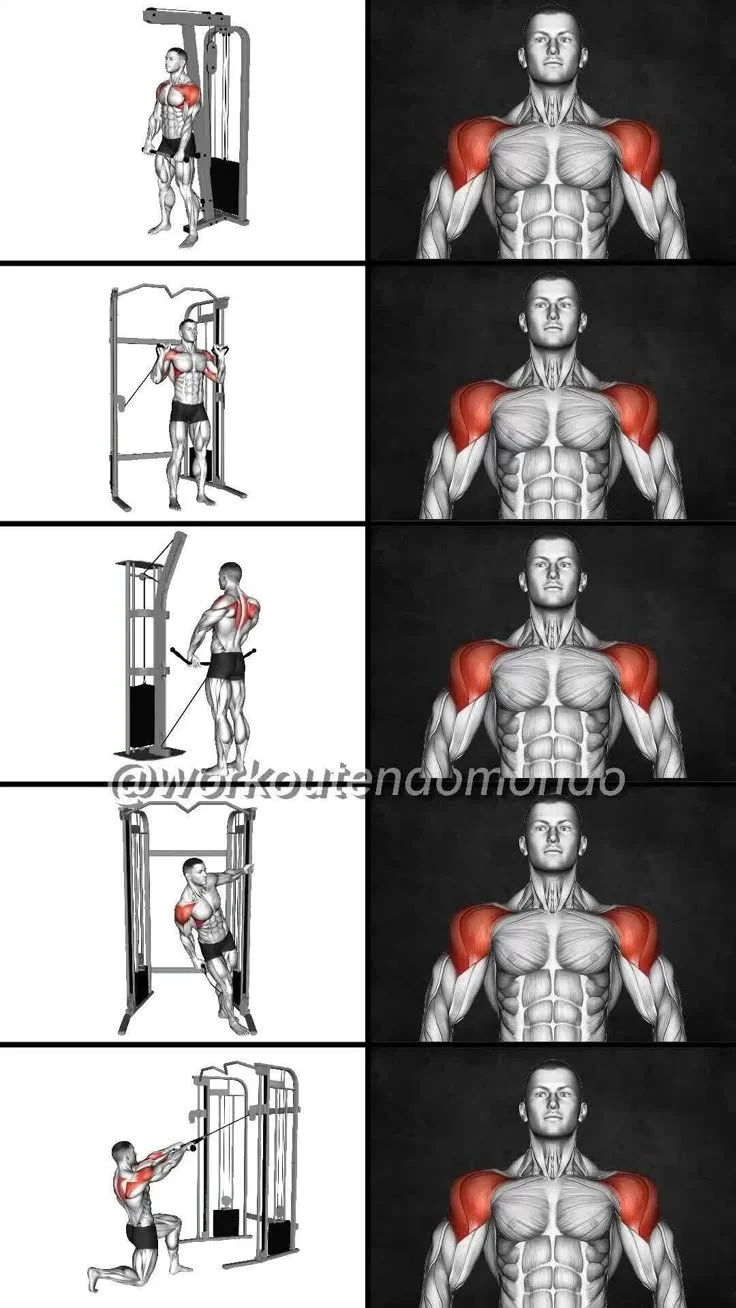
Enhance Your Shoulders: Top 5 Cable Exercises
Well-developed shoulders improve posture, create balanced aesthetics, and support stronger pressing movements. Cables are uniquely effective for shoulder training because they maintain continuous tension through the range of motion, allow for smooth unilateral work, and enable precise angle variations to target all three deltoid heads. Before you start, pair this work with solid core stability — for example, include focused core sessions like the ones in this guide: Work Your Abs to Exhaustion: 5 Abs Exercises.
Below are five cable exercises that together will build size, strength, and shape across the anterior, medial, and posterior deltoids. For each exercise I’ll include setup, execution, coaching cues, rep ranges, and common mistakes.
1. Single-Arm Cable Overhead Press
- Setup: Attach a single handle to the low pulley. Stand facing away from the machine with the handle at shoulder height. Grip the handle and step forward slightly for tension.
- Execution: Press the handle overhead until your elbow is fully extended, keeping your wrist neutral. Lower under control to shoulder height.
- Cues: Keep the torso braced, ribs down, and avoid excessive lumbar extension. Drive with the shoulder, not the traps.
- Reps/Sets: 3–4 sets of 6–10 reps per arm for strength; 8–12 for hypertrophy.
- Common mistakes: Letting the elbow flare forward or using hip drive to cheat the movement.
Why do single-arm presses? They reveal and correct unilateral imbalances and force your core to stabilize against rotation.
2. Cable Lateral Raise (High-Pulley)
- Setup: Set the pulley to the lowest position, stand side-on, and hold the handle in the hand farthest from the machine.
- Execution: With a slight bend in the elbow, raise your arm out to the side to about shoulder height, leading with the elbow. Pause briefly at the top.
- Cues: Keep the movement smooth and controlled; avoid swinging. Think of lifting with the middle deltoid, not the traps.
- Reps/Sets: 3–4 sets of 10–15 reps.
- Common mistakes: Shrugging the shoulder, using momentum, or raising above shoulder level.
Cable lateral raises offer constant tension and allow slight angle changes (lean forward 10–15° to emphasize the posterior deltoid).
3. Cable Face Pull
- Setup: Use a rope attachment on a high pulley. Stand facing the machine, grab the rope with a neutral (palms facing) grip.
- Execution: Pull the rope toward your upper chest/face, flaring the elbows out and squeezing the rear delts and upper back. Control the return.
- Cues: Pinch shoulder blades together; think “pull the elbows back.” Keep the neck long and chest up.
- Reps/Sets: 3–4 sets of 12–15 reps.
- Common mistakes: Letting the wrists collapse, using too much weight, or letting the shoulders round forward.
Face pulls are essential for rear-delt development and shoulder health, improving posture and counteracting bench-dominant training.
4. Cable Front Raise (Single or Double)
- Setup: Attach a straight bar or single handles to low pulleys. Stand in the center for double-arm work or side-on for single-arm.
- Execution: With a slight bend in the elbow, lift the handle(s) straight in front of you to around shoulder height, then lower slowly.
- Cues: Avoid swinging or using hip drive. Keep scapula stable and ribs down.
- Reps/Sets: 3 sets of 10–12 reps.
- Common mistakes: Using momentum, locking the elbows, or over-rotating the shoulder.
Front raises emphasize the anterior deltoid and can be used as a finisher after pressing work.
5. Bent-Over Cable Reverse Fly (Rear Delt Row Variation)
- Setup: Set two pulleys to the lowest position. Cross them so your right hand holds the left handle and vice versa. Hinge at the hips until torso is near-parallel to the floor.
- Execution: With a slight elbow bend, pull the handles out and back in a wide arc, targeting the rear delts. Squeeze at peak contraction.
- Cues: Lead with the elbows, keep the neck neutral, and avoid collapsing the chest.
- Reps/Sets: 3–4 sets of 10–15 reps.
- Common mistakes: Relying on momentum or turning it into a lat-dominant row.
This movement isolates the posterior deltoid while preserving continuous tension from the cables.
Programming Tips
- Order: Start with compound pressing (single-arm overhead press) then move to lateral and posterior-focused isolation movements.
- Volume: For hypertrophy, aim for 10–20 sets per week for shoulders split across sessions.
- Tempo: Use a 1–2 second concentric and 2–3 second eccentric tempo to increase time under tension.
- Progressive Overload: Increase weight, reps, or add a pause/slow eccentric every 2–4 weeks.
- Pairing: Combine shoulder days with pressing and arm work; balance heavy pressing with targeted triceps training like these recommended movements: 5 Best Exercises to Build Triceps.
Recovery is key—prioritize sleep and nutrition, and avoid training shoulders heavy on back-to-back days.
Common Faults and Fixes
- Pain or impingement: Reduce range, lower the weight, and emphasize controlled motion. Replace with machine or band variations if needed.
- Dominant traps: Reduce load, cue scapular depression, and focus on elbow-led movement.
- Imbalanced development: Use unilateral cable exercises to identify and correct side-to-side strength differences.
Variations to Keep Progressing
- Change pulleys: Small adjustments in pulley height shift emphasis between deltoid heads.
- Tempo sets: Slow eccentrics or pause reps increase time under tension.
- Pre-exhaust: Start with isolation (e.g., lateral raises) before presses to recruit delts more directly.
Conclusion
For a complete reference and more exercise variations to build both size and strength in your deltoids, see this roundup: 6 Best Cable Shoulder Exercises for Size and Strength.



GIPHY App Key not set. Please check settings