

 amanda cohen
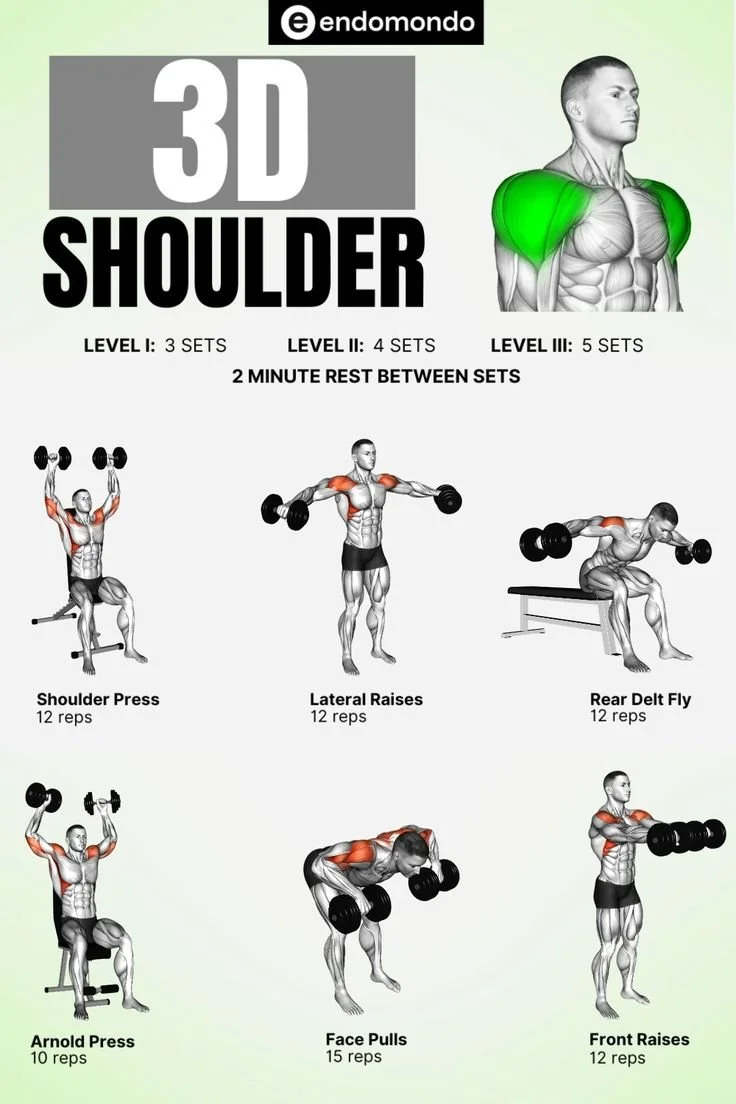
Get 3D Shoulders: Build Strength and Definition Fast
Introduction
Strong, well-shaped shoulders not only improve your physique — they increase pressing strength, improve posture, and reduce injury risk. Building “3D” shoulders means developing all three heads of the deltoid (anterior, medial, posterior) so your shoulders look full from every angle. To stay consistent and motivated, pair solid training with the right mindset — a helpful reflection on long-term progress can be found in this letter to yourself: https://tavof.com/a-letter-to-my-younger-self-on-bodybuilding-and-life/.
How the shoulder works (quick anatomy)
- Anterior deltoid: front — drives pressing and raises the arm forward.
- Medial (lateral) deltoid: side — gives width; key for that capped look.
- Posterior deltoid: rear — balances posture and creates depth.
Training pillars for fast, visible results
-
Prioritize compound lifts
- Overhead presses (barbell or dumbbell) are the foundation for strength and mass.
- Push and pull balance matters: horizontal rows and face pulls protect the rear delts.
-
Use targeted isolation with intent
- Lateral raises, bent-over reverse flyes, and cable lateral work shape individual heads.
- Train each head with specific exercises and emphasize tempo and full range of motion.
-
Progressive overload + frequency
- Aim to increase reps, weight, or quality of reps week to week.
- Train shoulders directly 2x per week for faster hypertrophy, with adequate recovery.
-
Rep ranges and volume
- Strength focus: 4–6 reps for heavy pressing.
- Hypertrophy focus: 6–15 reps for presses and 8–20 reps for isolation work.
- Total weekly sets per head: ~10–20 sets, adjusted by experience and recovery.
Key exercises (do these regularly)
- Overhead press (barbell or dumbbell) — main mass builder.
- Incline dumbbell press — emphasizes front delts.
- Dumbbell lateral raises (strict form) — builds medial width.
- Cable lateral raises (leaning away) — constant tension.
- Face pulls and reverse flyes — rear delt and rotator cuff health.
- Arnold presses — mix of front and medial stimulation.
- Upright rows (wide grip, light) — optional for lateral emphasis if mobility allows.
Technique tips that speed progress
- Lead each rep from muscle contraction, not momentum. Control the eccentric.
- For lateral raises, think “lift to the elbow” and keep a small bend in the elbow.
- Use partials or drop sets safely at the end of a session for extra stimulus.
- Prioritize scapular control and breathing during heavy overhead work.
- Warm up rotator cuff and thoracic mobility to support heavier pressing.
Sample 2x-week shoulder-focused microcycle
Day A — Strength + Volume
- Barbell overhead press: 4 sets x 4–6 reps
- Incline dumbbell press: 3 x 8–10
- Bent-over reverse flyes: 3 x 10–15
- Dumbbell lateral raises: 4 x 10–15 (last set drop set)
Day B — Hypertrophy + Isolation
- Seated dumbbell press: 3 x 8–12
- Cable lateral raises: 4 x 12–20
- Face pulls: 4 x 12–20
- Rear-delt row (chest-supported): 3 x 10–15
- Farmer carries or loaded carry for shoulder stability: 2 x 40–60 seconds
Nutrition and recovery — don’t skip these
- Eat a small calorie surplus if you want faster size gains; target 0.2–0.5% bodyweight/week.
- Protein target: ~1.6–2.2 g/kg of bodyweight per day.
- Sleep: 7–9 hours for best recovery and hormonal support.
- Use foam rolling, light band work, and mobility drills on off days.
Programming mistakes that stall shoulder growth
- Overemphasizing pressing and ignoring lateral/rear delt work.
- Using too much momentum on lateral raises (limits stimulus).
- Under-recovering between shoulder-intensive sessions.
- Avoiding light rotator cuff work — small muscles prevent big injuries.
Accessory tweaks and tailoring
- If your medial delts lag, increase lateral raise volume and frequency.
- If your rear delts are weak, prioritize rows and reverse flyes early in sessions.
- For women or anyone focused on shaping rather than heavy mass, higher rep ranges and focused isolation can produce refined definition — see strategies focused on sculpting upper limbs here: https://tavof.com/empowering-women-sculpting-arms-with-precision-for-strength-and-style/.
Quick finisher (do 1–2 times a week)
- Ladder set: 12, 10, 8, 6 reps of dumbbell lateral raises with 20–30s rest.
- Follow with 3 sets of face pulls for 15–20 reps.
Tracking progress
- Take monthly photos from multiple angles and measure shoulder circumference.
- Log weights, reps, and how each lift felt. Small consistent increases compound quickly.
- Reassess program every 6–8 weeks and rotate exercises to avoid plateaus.
Conclusion
Want a concise, science-backed checklist to speed shoulder width and development? Read this practical guide: How I Grew Wider Shoulders FAST (5 Science-Based Tips). It complements the program above with evidence-based tweaks to accelerate visible width and 3D shape.



GIPHY App Key not set. Please check settings