
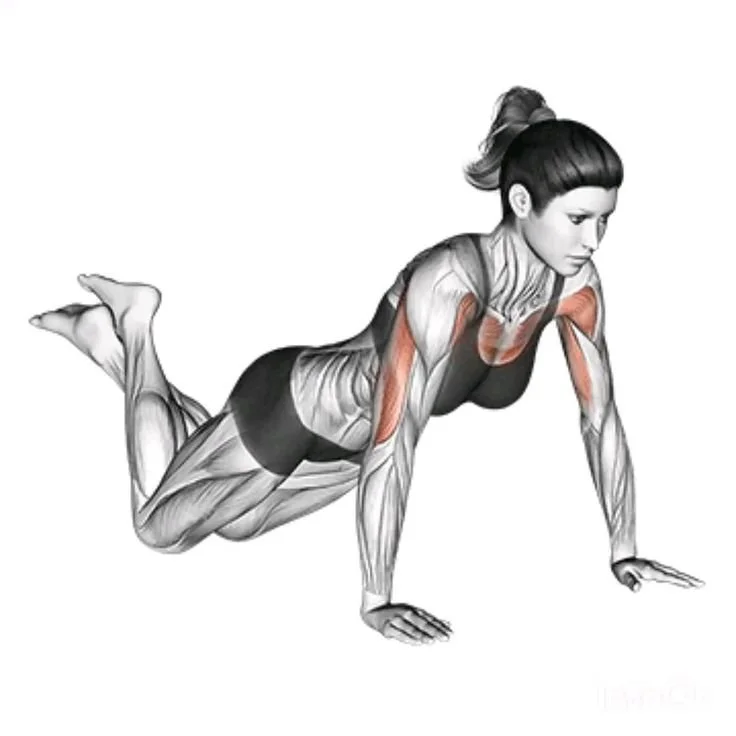
Knee Push-Up: Gentle Strength, Big Results
The knee push-up is a beginner-friendly variation of the classic push-up that builds upper-body strength while reducing load on the shoulders and core. It’s ideal for beginners, people returning from injury, or anyone wanting to practice perfect push-up mechanics before progressing. For a broader bodyweight chest routine that pairs well with knee push-ups, check out this chest bodyweight workout guide.

Why choose the knee push-up?
- Lowers the resistance compared with full push-ups, making consistent practice easier.
- Strengthens the chest, triceps, and anterior shoulders while allowing greater control of form.
- Helps ingrain scapular stability and proper elbow path before adding full-body weight.
How to perform a proper knee push-up
- Start on all fours with hands slightly wider than shoulder-width and knees on the mat; keep ankles crossed or neutral.
- Walk your hands forward so your body forms a straight line from head to knees — avoid sagging hips.
- Brace your core and retract the shoulder blades slightly (a small downward/outward pull).
- Inhale, then bend the elbows and lower your chest toward the floor, keeping elbows at about a 45-degree angle from the torso.
- Pause briefly near the bottom, then exhale and press back up to the starting position, fully extending the elbows without locking them.
Programming and progressions
- Start with 2–4 sets of 6–12 reps, focusing on quality over quantity.
- Once you can perform 3 sets of 12 with strict form, advance by elevating the feet slightly or transitioning to half push-ups (from toes with knees still near the floor) before attempting full push-ups.
- For shoulder and pressing balance, pairing with a targeted shoulder routine can help; consider this dumbbell shoulder routine to strengthen all three heads of the deltoid and support pressing mechanics.
Common mistakes and quick fixes
- Hips sagging: tighten the core and think about pulling the belly button toward the spine.
- Hands too far forward: reposition so the wrists align under the elbows at the bottom of the movement.
- Flared elbows: keep elbows closer to 45 degrees to protect the shoulder joint.
Variations and tips
- Narrow (diamond) knee push-ups target the triceps more.
- Slow eccentric (3–5 seconds down) builds control and strength.
- Add isometric holds at the bottom or half-reps to overcome sticking points.

Conclusion
Knee push-ups are an effective, low-risk way to build pressing strength and establish solid mechanics before advancing to full push-ups; for a deeper look at how the kinetic chain affects shoulder and scapular function, see this research on the kinetic chain’s influence on scapular muscle activity.


GIPHY App Key not set. Please check settings